
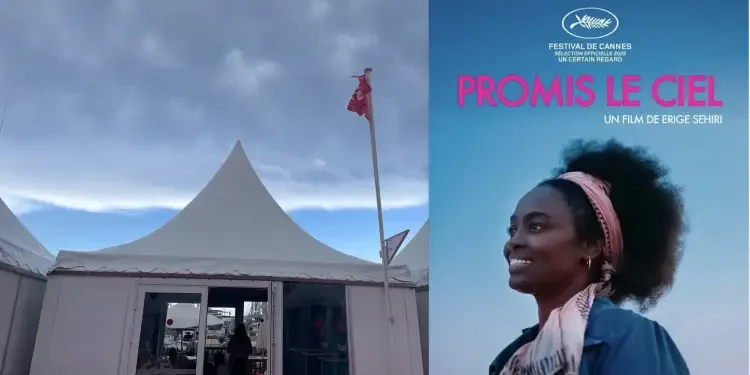
At the 78th Cannes Film Festival, Tunisia reaffirmed its presence within the International Village, at the Pantiero space, with an official pavilion organized by the National Centre for Cinema and Image (CNCI) under the supervision of the Ministry of Cultural Affairs. The pavilion was intended to showcase the rise of Tunisian cinema, build bridges internationally, and spotlight local talent.
Yet while the structure exists, its activation and visibility raise serious questions.
Opening Without a Program
On the festival’s opening day, the pavilion opened its doors without a scheduled program. Until the afternoon, no events were announced, no official communications had been issued, and no invitations sent. Only late in the evening was a single statement published on the CNCI’s Facebook page, listing the few events planned for the year:
- Wednesday, May 15, 7:00 PM – A tribute to the team behind Promis le ciel, directed by Erige Sehiri, selected for the Un Certain Regard section. This symbolic event was meant to celebrate a Tunisian film in the official selection and underscore the continuity of a sensitive perspective on youth, following Sous les figues in 2022.
- Friday, May 17, 11:00 AM – A media briefing on the 36th Carthage Film Days (JCC), to present the next edition’s highlights, its new directions, and potentially its ambitions for regional and international visibility.
- Sunday, May 19, 11:00 AM – A roundtable titled Tunisian Cinema: Past and Present, bringing together professionals and observers to discuss cinematic memory, industry transformations, and emerging voices in Tunisia’s film landscape.
Late Announcement Undermines Impact
Unfortunately, the program was announced far too late. At Cannes, time is reserved, not taken. In the days leading up to the festival, industry professionals finalize their schedules, respond to invitations, and select panels, receptions, and meetings. Announcing events the day before the festival leaves little chance that attendees can adjust their schedules to include the Tunisian pavilion.
Meanwhile, other countries in the region demonstrated high levels of preparation and strategy. The Egyptian, Iraqi, Jordanian, and Palestinian pavilions, among others, announced their programs weeks in advance, shared guest lists, panel topics, and screenings, and promoted content via social media, press releases, newsletters, and visual assets.
The Tunisian pavilion? One late statement in Arabic only, without visuals, translations, or press support. This minimalist and ineffective communication hinders its ability to attract producers, distributors, and investors, and disconnects Tunisia from the global standards of festival communication.
Missed Opportunities
Several elements could have been leveraged to strengthen Tunisia’s presence:
- A Tunisian film opening Un Certain Regard (Promis le ciel), a rare opportunity for international exposure.
- A director already recognized at Cannes.
- A new generation of emerging talent.
- Renewed interest in Tunisia as a filming location.
Yet the pavilion did nothing to promote the film: no press releases, no invitations to industry professionals or journalists, and no visible posters at the pavilion to highlight Tunisia’s achievement.
Similarly, the roundtable on Tunisian cinema raises questions: who are the participants? Will it include only Tunisians? Are there well-known names to attract attention, such as Hend Sabry? In comparison, other Arab pavilions featured prominent stars and industry figures.
Conclusion
Tunisia has the talent and resources: creative young professionals capable of working according to modern international standards. What is lacking is trust, funding, and the freedom to act on time.
While other Arab countries are building cohesive cultural diplomacy on the global stage, Tunisia continues to project an image of disorganization, delay, and misalignment with professional festival norms, failing to convert its cinematic strengths into genuine opportunities.
Hope for Recovery
There is hope that the coming days may help partially compensate for this lack of initiative. But at Cannes, lost opportunities are rarely recovered.


