
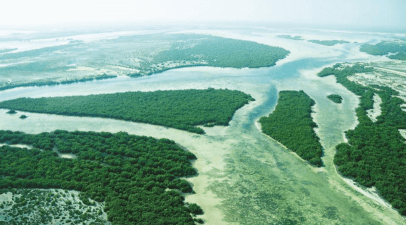
Abu Dhabi Environmental Agency and Dindra Partner to Advance Mangrove Rehabilitation Techniques
ABU DHABI, October 13- The Environmental Agency in Abu Dhabi has unveiled its collaboration with "Dindra," a global company specializing in environmental technologies, in partnership with the "Holding Company" (ADQ), to develop innovative techniques for mangrove rehabilitation.
The project is part of the Al Qurm Initiative in Abu Dhabi, recently launched by the Authority, reflecting the Emirate of Abu Dhabi's commitment to effective climate action on multiple fronts. The project also aligns with strategic efforts and initiatives during the Year of Sustainability.
This partnership will provide additional investments in resources and cutting-edge technologies that will enhance Abu Dhabi efforts to plant and rehabilitate mangroves.
As part of this partnership, the Authority will offer data-driven guidance through its specialized experts in mangrove cultivation. These experts have worked on implementing several mangrove rehabilitation projects that integrate technology and traditional knowledge into the local environment. These projects, developed by the Authority and covering all regions of the Emirate, aim to bolster rehabilitation efforts.
The Environmental Agency will also assist in identifying suitable lands for cultivation and the methodology to be employed, in addition to sharing its knowledge of the local environment and providing the results of a comprehensive mangrove rehabilitation survey that has classified and initially highlighted areas conducive to planting and rehabilitation.
Meanwhile, "Dindra" will provide advanced technology and services using remote sensing technology, relying on drones in a data-driven approach to enhance the rehabilitation process and improve outcomes.
Following the assessment and planting of the area, aerial monitoring and field surveys will be conducted to better identify germination rates and track the success of ecosystem restoration operations. These surveys will be carried out every four weeks over a three-month period, and later, on a quarterly basis during the first year, followed by an annual survey on an ongoing basis.
The cooperation will also entail additional surveys using remote sensing technology to enhance the Authority's knowledge and understanding of mangroves, their locations, and potential sites requiring rehabilitation. An additional layer of data will be added through the use of advanced monitoring technologies, covering 20,000 hectares through drones equipped with ultra-resolution (RGB) sensors for multispectral data acquisition.
The survey will also involve the collection of criteria that will enable the Environmental Agency to determine the state and health of mangroves. These data will help identify gaps and potential impacts, determine tidal levels, salinity, and land elevation, and support scientific methods and approaches monitored by the Abu Dhabi Environmental Agency regarding the pursuit of a comprehensive and more efficient approach to restoring and monitoring mangrove ecosystems.
Ahmed Al Hashemi, Executive Director of the Land and Marine Biodiversity Sector at the Environmental Agency in Abu Dhabi, stated: "Through this collaboration with 'Dindra,' and within the framework of Abu Dhabi's climate change strategy, as well as our partnership with the Holding Company, we will work towards implementing a coastal ecosystem restoration project, particularly for mangroves, and ensuring the project's success. We will utilize advanced monitoring and surveillance tools using drones to increase the accuracy of ecosystem-related data before selecting the most suitable areas for rehabilitation. Following that, we will commence mangrove planting as part of the Al Mangrove Initiative in Abu Dhabi, which supports the UAE's plan to plant 100 million mangroves by 2030."
The ultra-resolution RGB data systems that Dindra will collect will enable the identification of animal species and their activities, as well as the impacts of pests and human activities, and provide a comprehensive assessment of the mangrove population.


