
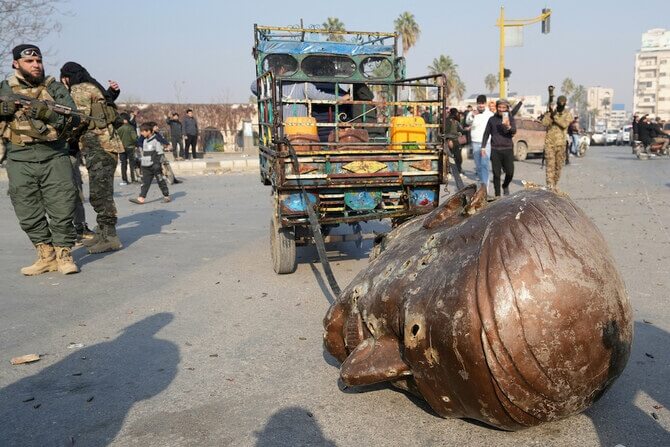
Syrians both within the country and among the diaspora witnessed a monumental shift in their nation’s history. After over fifty years of authoritarian rule under the Assad family, the Syrian government collapsed, marking the dawn of a new era.
The dramatic fall of the Assad regime was led by Abu Mohammed Al-Golani, the leader of Hayat Tahrir Al-Sham (HTS). Early in the morning, HTS forces took control of Damascus, bringing an abrupt end to the Assad family's reign, which had been entrenched in Syria for decades. This sudden development came just weeks after the strategic capture of Aleppo, further destabilizing the regime's hold on the country.
In an unexpected move, Prime Minister Mohammed Ghazi Al-Jalali was seen being escorted by Al-Golani's forces to a location where he reportedly handed over power. Meanwhile, anti-regime factions took to state-run television, declaring that President Bashar Assad had been deposed and announcing the release of all political prisoners.
In a striking turn of events, Assad and his immediate family were reported to have fled to Russia, where they were granted asylum. Russian news agencies, quoting Kremlin sources, confirmed the news of Assad’s arrival in Moscow, citing humanitarian reasons for the asylum.
Israeli Prime Minister Benjamin Netanyahu, reacting to the regime’s collapse, ordered the Israeli military to take control of a demilitarized buffer zone on the Golan Heights, which is located along the Syria-Israel border. Netanyahu asserted that this move was necessary to prevent any hostile force from gaining a foothold near Israel’s borders.
“We will not allow any adversarial entity to establish itself on our borders,” Netanyahu remarked, adding that the fall of Assad was a direct consequence of Israeli actions against Iran and Hezbollah in the region.
The international community reacted swiftly to the change in leadership. Saudi Arabia, mindful of the potential instability, urged for coordinated efforts to ensure that Syria would not descend into further chaos.
“The Kingdom expresses its unwavering support for the Syrian people and their right to choose their future,” a statement from Saudi Arabia’s Foreign Ministry read. “It is crucial that all efforts are made to preserve Syria’s unity and the cohesion of its citizens to avoid fragmentation and unrest.”
Meanwhile, the United States expressed its concern, but also reassured its allies of its continued commitment to securing the region. A spokesperson for the US National Security Council remarked, “The events unfolding in Syria are being closely monitored by President Biden and his team, and we remain in constant contact with our regional partners. The United States will maintain its military presence in eastern Syria and ensure the fight against Daesh continues unabated.”
The United Kingdom, through Prime Minister Keir Starmer, welcomed the regime's downfall, emphasizing the suffering that Syrians had endured for years under Assad’s brutal leadership.
“We support the Syrian people in their fight for a better future. The events of the past days represent a significant and unprecedented shift, and we are working with our international partners to ensure that stability is restored,” Starmer stated.
In Turkey, Foreign Minister Hakan Fidan urged caution and a measured response from all international actors as the situation in Syria remained volatile.
“Turkiye calls on all nations involved to act responsibly and prioritize stability in the region,” Fidan stated.
As the dust settles over Damascus, the world watches closely as the people of Syria begin the arduous process of rebuilding and redefining their future, free from the shackles of a regime that has dominated their lives for over fifty years.


